Xilinx Phy VideoPhy Driver
Table of Contents
Introduction
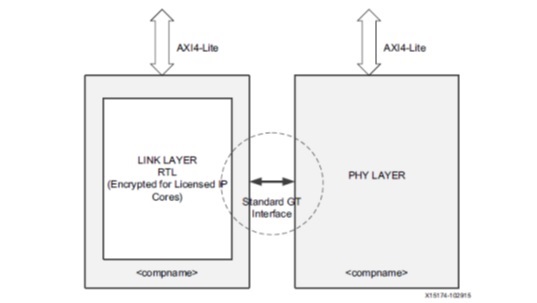
Video IP Layer
Driver Overview
The PHY is intended to simplify the use of serial transceivers and adds domain-specific configurability. The Video PHY Controller IP/Driver is not intended to be used as a stand alone IP and must be used with Xilinx Video MACs such as HDMI 1.4/2.0 Transmitter/Receiver Subsystems and DisplayPort TX/RX Subsystems.As such PHY Linux Driver is implemented within the kernel PHY framework and is tightly coupled with HDMI Rx/Tx Linux drivers. This driver also hosts the common video files shared between the 3 Xilinx connectivity drivers (Vphy, HDMI Rx and HDMI Tx) and exports the relevant API’s for inter-driver communication. On kernel boot-up both HDMI Rx & Tx drivers will request 3 PHY lanes each for Rx & Tx and will defer until PNY driver has been initialized.
IP/Driver Features
| IP Feature | 2018.1 - 2019.1 | 2019.2 and onward | 2020.1 - 2023.2 |
| IP Version Supported | 2.2 | 2.2 | 2.2 |
AXI4-Lite support for register accesses | Y | Y | Y |
Protocol Support: Display Port, HDMI | Only HDMI | Only HDMI | DisplayPort and HDMI |
Full transceiver dynamic reconfiguration port (DRP) accesses and transceiver functions | Y | Y | Y |
Independent TX and RX path line rates (device specific) | Y | Y | Y |
Single quad support | Y | Y | Y |
Phase-locked loop (PLL) switching support from software | Y | Y | Y |
Transmit and Receiver user clocking | Y | Y | Y |
Protocol specific functions (For example, HDMI Clock Detector) | Y | Y | Y |
Non-integer data recovery unit (NI-DRU) support for lower line rates. NI-DRU support is for the HDMI protocol only. | Y | Y | Y |
Advanced Clocking Support | N | N | Y |
| Use of 4th GT channel as TX TMDS clock | N | Y | Y |
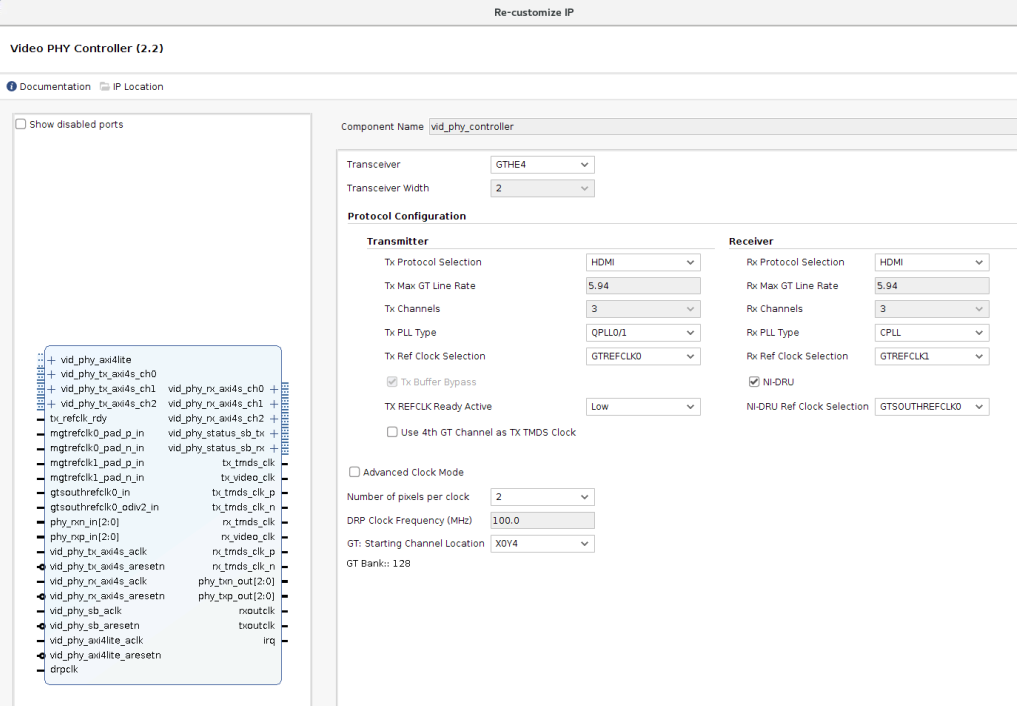
HW IP Configuration
Known Issues and Limitations
- Only 1 IP configuration supported (listed in HW IP Configuration section)
- Supports only HDMI protocol at this time
Kernel Configuration Options for Driver
2018.1 and onwards: CONFIG_ARCH_ZYNQMP and CONFIG_GENERIC_PHY should be enabledDriver is added as an out-of-tree kernel module and therefore requires no driver specific kernel configuration However to enable the driver user must include it in the rootfs. Following steps are required enable the driver
- Make sure the meta-user layer has the recipe-hdmi included
- For 2019.2 onwards
Add the recipe to petalinux image. Edit ./meta-user/conf/user-rootfsconfig and add the new recipe at the end
CONFIG_kernel-module-hdmi
- For 2018.1 to 2019.1
- Add the recipe to petalinux image. Edit ./meta-user/recipes-core/images/petalinux-image-full.bbappend and add the new recipe at the end
- NOTE - While using 2018.1 petalinux, the file name was ./meta-user/recipes-core/images/petalinux-image.bbappend
- Add the recipe to petalinux image. Edit ./meta-user/recipes-core/images/petalinux-image-full.bbappend and add the new recipe at the end
IMAGE_INSTALL_append = " kernel-module-hdmi"
- Next include the driver in the rootfs
% petalinux-config -c rootfs
- Select "user-pakages->modules->kernel-module-hdmi", save and exit
- Build the project
%petalinux-build
Device Tree Binding
The dts node should be defined with correct hardware configuration. How to define the node is documented inDEBUG Capability
Video PHY Linux driver implements the capability to tap IP status at pre-defined points in the control flow. User can enable the debug taps by uncommenting the pre-processor directive (#define DEBUG) to monitor the progress within the driver. All debug prints are sent to serial console and can be viewed in kernel dmesg bufferHow to capture vphy state machine logs
Run below command to print the vphy state machine logs or vphy information
# For Logs, run anyone of the below. It will give logs for both TX and RX state machine logs of vphy. Do note that its a destructive logging. Once you run below command, the logs buffer will become empty.
cat /sys/devices/platform/amba_pl\@0/80080000.v_hdmi_tx_ss/vphy_info
or
cat /sys/devices/platform/amba_pl\@0/80000000.v_hdmi_rx_ss/vphy_log

# For vphy info, run below commands
cat /sys/devices/platform/amba_pl\@0/80080000.v_hdmi_tx_ss/vphy_log
or
cat /sys/devices/platform/amba_pl\@0/80000000.v_hdmi_rx_ss/vphy_info
How to capture register dump
Create a script on target and name it as dumpmem.sh. Paste below content in that script.
#!/bin/sh
# Usage dumpmem.sh ADDR OFFSET
base=$1
counter=0
while [ $counter -lt $2 ];
do
    offset=$(($counter*4))
    reg_addr=$(($base + $offset))
    reg_addr=`printf "0x%X\n" $reg_addr`
    output=$(devmem $reg_addr)
    delimiter=": "
    echo $reg_addr$delimiter$output
    counter=$(($counter+1))
done
echo All done
Now run below command to dump the registers of Vphy
# In the below command, first parameter is the base address of the IP (vphy) in this case and second parameter is the number of registers to be read
./dumpmem.sh 0x80120000 206
Boards Supported
Driver has been tested on following boards
- zcu102 Rev 1.0
- Zcu106 Rev 1.0
Driver has been tested with HDMI FrameBuffer Example Design design
Change Log
2024.1
2023.2
- Commits
- dt-bindings: hdmi-tx-ss: Fix the phy instance names
- dt-bindings: hdmi-rx-ss: Fix the phy instance names
- dt-bindings: vphy: Update phy lane nodes as per the IP
- phy: Fix max lanes supported by video phy in HDMI 2.O mode
- Revert "Create 0001-hdmitx-Fixed-hdmi-compilation-with-kernel-6.1.patch"
- Create 0001-hdmitx-Fixed-hdmi-compilation-with-kernel-6.1.patch
2023.1
2022.2
2022.1
- Commits
- hdmitx: Remove registring with hdmi-audio-codec driver
- hdmitx: Add support for 3 planar YUV444 10bpc
- hdmitx: Workaround for Versal display not coming up on boot
- hdmi: Fix the clean path in Makefile
- hdmitx: Add VPSS bridge support
- dt:bindings: Add entry to support vpss bridge
- videocommon: Added new attributes to the VIC table
- videocommon: Add enum for 64:27 and 256:135 aspect ratio
- hdmitx: Add NULL reference check for connector state
- hdmi: Fix compilation errors with v5.15 kernel
- dp159: Fix comments for setting VSWING_DATA/CLK
2021.2
- Commits
2021.1
- Summary
- Update the phy driver based on bare metal driver updates to components like hdcp, video common library, etc.
- Commits
- license: Update the license for 2021.1
- phy: hdmiphy1: Updates for 2021.1
- common: hdcp22_tx: Update the driver for 2021.1
- common: hdcp22_rx: Update driver for 2021.1
- common: hdcp1x: Update driver for 2021.1
- common: xhdmi_example: Fix styling issue in aes256
- common: tmrctr: Update the tmrctr driver
- commond: video_common: Update for 2021.1
- common: video_common: Fix the timings for 1440x480/576
- common: Update v_hdmi_common for 2021.1
- Fix compilation error for v5.10 kernel
2020.2
- Summary
- Fix coverity warnings
- Remove GT workaround patch
- Add helpers to parse and generate HDR Aux packets
- Commits
2020.1
- Summary
- Add support for Versal Phy (HDMI GT controller) in same driver
- Add minor fixes and updates
- Fix sha
- Add VIC entries
- memset packet structure to 0 while generating
- Commits
2019.2
- Summary
- Driver updated for 2019.2
- Enabled TX 4th GT channel support
- Enabled suspend and resume
- Updated license file for 2019.2
- Commits
2019.1
- Summary
- Made driver compliant with DTG tool generated Device tree nodes and updated the documentation.
- Updated license file for 2019.1
- Commits
2018.3
- Summary
- Made dru clock optional depending on NI-DRU configured value
- Commits
2018.1
- Summary
- Added 0.5% margin to user clock frequency
- Commits
Related Links
- Linux Drivers
- HDMI Tx Driver
- HDMI Rx Driver
- HDMI FrameBuffer Example Design 2019.2
- HDMI FrameBuffer Example Design 2019.1
- HDMI FrameBuffer Example Design 2018.3
- HDMI FrameBuffer Example Design 2018.1
© Copyright 2019 - 2022 Xilinx Inc. Privacy Policy